This Report documents how a World Bank-financed energy project in Afghanistan was derailed by corruption, fraud, and institutional failure, at significant cost to the Afghan people.
In 2015, the World Bank designed a straightforward contract extension to keep Unicon Ltd. working on Afghanistan’s strategically vital Mazar-e-Sharif Gas-to-Power project – a logical decision given Unicon’s unmatched on-the-ground experience in Afghan gas infrastructure. Days after the Afghan Minister signed the extension approval documents, a bribe was demanded. Unicon refused. The signed extension was immediately torn up, and a fresh tender was launched in its place. The corruption that derailed this project did not begin with a failed bid – it began before the competition even started.
What followed in that tender process is where the story becomes particularly striking. Curtis, Mallet-Prevost, Colt & Mosle LLP – a prominent New York law firm that also served as the World Bank’s own external counsel – submitted a proposal that contained the unauthorised signature of a Unicon expert, Lawrence Burke Files, appearing twice in Curtis’s submission: once in a Power of Attorney and once in a CV filed under another person’s name. The person named in that CV, a “Jean Paul Dubois,” could not be located, and key details of his supposed background appear to have been deliberately omitted. On any straightforward reading, the use of another person’s signature in legal tender documents without authorisation is fraud. This is not a characterisation – it is a factual description of what the documents show.
The fraud allegation is made more serious by what surrounded it. Curtis received the highest technical score by a significant margin, despite submitting a proposal that was, on its face, materially weak. Its methodology section largely reproduced the government’s own Terms of Reference and contained tasks copied directly from Unicon’s prior contract rather than addressing the actual scope of the Mazar Gas-to-Power work.
When Unicon submitted the fraud evidence to the World Bank’s Integrity Vice Presidency – naming the Bank’s own external counsel as the subject – the Bank acknowledged receipt, assigned a reference number, and then closed the matter with no explanation and no engagement with the documentary evidence. Unicon then notified Curtis directly, provided the full evidentiary record, and gave the firm 60 days to investigate and refute the allegations. Curtis did not respond – not within the deadline and not nearly a year and a half later.
This Report is also the first chapter of a wider story. The collapse of the tainted procurement process described in this Report did not end the project. It moved the same Mazar Gas-to-Power initiative into a new contractual form. After procurement responsibility passed to a different ministry, the same project re-emerged as the SMPL Contract. A separate report, World Bank Misconduct in Afghanistan: A Case of Extortion, Theft, and Retaliation, begins with that later phase and shows what followed when Unicon Ltd. was brought back into the repackaged project: renewed extortion for bribes, non-payment for services provided, retaliation, the World Bank’s continued protection of corrupt actors, and the wider campaign against Unicon Ltd. that followed.
_____________________
Downloads:
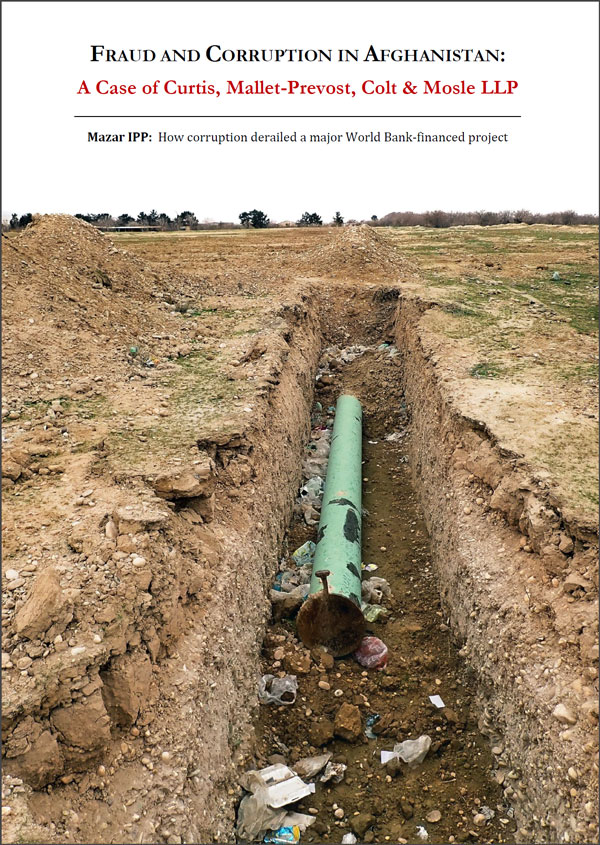
The Report – A Case of Curtis, Mallet-Prevost, Colt & Mosle
Letter, Email to Curtis – 14 November 2024
Letter to the World Bank – 9 July 2024
World Bank Benefiting from Corruption – including Exhibits 1 to 26